
Good posture is one of the most important elements of a healthy spine, yet it is something to which most of us do not pay much attention. In fact, most of us are so accustomed to poor posture, that correct posture feels unnatural, uncomfortable, and well, just plain wrong. However, our bodies are designed in such a way that if we are properly aligned, it takes very little muscular work to remain in an upright position. In fact, as prescribed by teachers of the Alexander Technique, healthy posture feels long, open and easy.
So, how do you know if you have good posture? And if you don’t, how do you fix it? One way is to consult with a certified Alexander Technique teacher, IM=X® Pilates personal trainer, physical therapist, or other qualified professional. But if that is not an option, there are a few things you can do yourself.
First, see how things stack up. The best way to do this is to have a friend help you by taking a picture of you from the side and from the front. A mirror will work too, but it is not as effective. Stand comfortably with your weight on both feet, in your “normal” posture, without trying to “stand up straight.”
Here is how things should look:
From the side – You should be able to draw a straight line through the center of your ear, shoulder joint, hip joint, knee, and ankle.
From the front – Ears, shoulders, hip bones, and ankle bones (inside/outside of each ankle) should be level; knees and toes face forward or very slightly turned outward, palms facing inward toward body.
how does it look?
If you notice uneven shoulders, hips, or knees, a sideways “S” curvature of the spine, or an excessive forward “C” curve in the upper back (“hunchback”) you should speak with a physician or physical therapist regarding treatment. It is also advisable to contact your physician if you have any conditions such as arthritis, osteoporosis, or any back/spinal conditions.
If you notice your chin jutting forward and shoulders rounded, your lower back arched, palms facing backward, and maybe your knees pressing back, then you have some more common postural deviations. These deviations are often the result of poor postural habits developed through years of hunching over desks and computers and slouching while driving and in front of the TV. Other things that adversely affect posture are excess weight gain and lack of exercise resulting in weak, inflexible muscles.
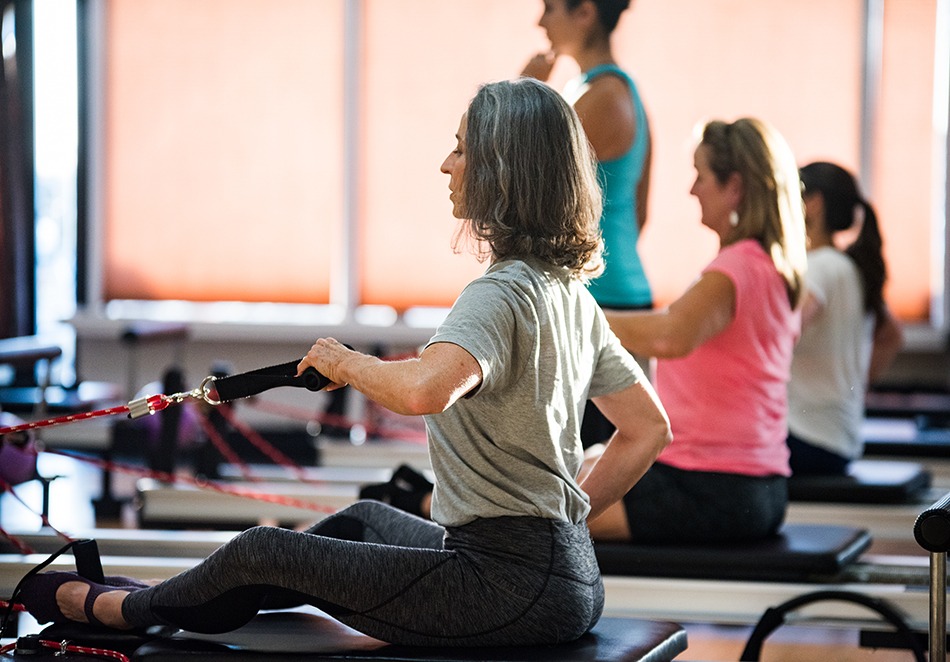
You may be able to improve your posture with a regular program of strengthening and stretching exercises. Where to find exercises to improve posture? IM=X® Pilates Studios offer workouts that include hundreds of exercises designed to develop the core muscles and straighten out some common postural deviations. Visit www.mxpilates.net for more information on the IMX Pilates personal trainers, classes, equipment, and workouts.
By Elyse McNergney, MA, M.Ed, Founder of IMX
IM=X® Pilates, Inc.
265 Madison Avenue, 2nd Floor
New York, NY 10016 | 800.IMX.1336
www.imxpilatesstudio.com | www.imxpilates.com